⋙ Download Free The Numerical Solution of Ordinary and Partial Differential Equations
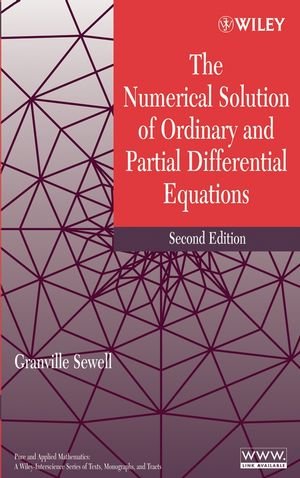
2nd Edition

You can download in the form of an ebook: pdf, kindle ebook, ms word here and more softfile type. The Numerical Solution of Ordinary and Partial Differential Equations, this is a great books that I think.

Editorial ReviewsReview"…a nice introduction to the topic… would serve nicely as test in an advanced undergraduate or beginning graduate level class in numerical analysis." (MAA Reviews, March 14, 2006)From the Back CoverLearn to write programs to solve ordinary and partial differential equations The Second Edition of this popular text provides an insightful introduction to the use of finite difference and finite element methods for the computational solution of ordinary and partial differential equations. Readers gain a thorough understanding of the theory underlying themethods presented in the text. The author emphasizes the practical steps involved in implementing the methods, culminating in readers learning how to write programs using FORTRAN90 and MATLAB® to solve ordinary and partial differential equations. The book begins with a review of direct methods for the solution of linear systems, with an emphasis on the special features of the linear systems that arise when differential equations are solved. The following four chapters introduce and analyze the more commonly used finite difference methods for solving a variety of problems, including ordinary and partial differential equations and initial value and boundary value problems. The techniques presented in these chapters, with the aid of carefully developed exercises and numerical examples, can be easilymastered by readers. The final chapter of the text presents the basic theory underlying the finite element method. Following the guidance offered in this chapter, readers gain a solid understanding of the method and discover how to use it to solve many problems. A special feature of the Second Edition is Appendix A, which describes a finite element program, PDE2D, developed by the author. Readers discover how PDE2D can be used to solve difficult partial differential equation problems, including nonlinear time-dependent and steady-state systems, and linear eigenvalue systems in 1D intervals, general 2D regions, and a wide range of simple 3D regions. The software itself is available to instructors who adopt the text to share with their students.About the AuthorGRANVILLE SEWELL, PHD, is Visiting Professor of Mathematics at Texas A&M University and Professor of Mathematics at the University of Texas at El Paso. He is the principal developer of PDE2D, a general-purpose partial differential equation solver. Dr. Sewell has written three books and published more than fifty articles on numerical methods and applications.Read more
I. Differential equations-Numerical solutions-Data processing. 2. Differential equations, Partial-Numerical solutions-Data processing. I. Title. 11. Pure and applied mathematics (John Wiley & Sons : Unnumbered) QA372.S4148 2005 5 18'.63-dc22 2005041773 Printed in the United States of America 10987654321
This book presents methods for the computational solution of differential equations, both ordinary and partial, time-dependent and steady-state. Finite difference methods are introduced and analyzed in the first four chapters, and finite element methods are studied in chapter five.
Learn to write programs to solve ordinary and partial differential equations The Second Edition of this popular text provides an insightful introduction to the use of finite difference and finite element methods for the computational solution of ordinary and partial differential equations.
The Numerical Solution of Ordinary and Partial Differential Equations - Kindle edition by Sewell, Granville. Download it once and read it on your Kindle device, PC, phones or tablets. Use features like bookmarks, note taking and highlighting while reading The Numerical Solution of Ordinary and Partial Differential Equations.
The Numerical Solution of Ordinary and Partial Differential Equations (Granville Sewell) December 1989. SIAM Review 31 (4):695-696. DOI: 10.1137/1031150. Authors: Murli M. Gupta. George Washington ...
The Numerical Solution of Ordinary and Partial Differential Equations is an introduction to the numerical solution of ordinary and partial differential equations. Finite difference methods for solving partial differential equations are mostly classical low order formulas, easy to program but not ideal for problems with poorly behaved solutions ...
Numerical Solution of Ordinary and Partial Differential Equations is based on a summer school held in Oxford in August-September 1961.. The book is organized into four parts. The first three cover the numerical solution of ordinary differential equations, integral equations, and partial differential equations of quasi-linear form.
This book presents methods for the computational solution of differential equations, both ordinary and partial, time-dependent and steady-state. Finite difference methods are introduced and analyzed in the first four chapters, and finite element methods are studied in chapter five. A very general-purpose and widely-used finite element program ...
Numerical methods are developed to solve certain types of linear and nonlinear partial differential equations to any desired degree of accuracy with the aid of equivalent electrical networks. The methods of solution of ordinary differential equations, both linear and nonlinear, follow as special cases. Three types of problems are considered:
Numerical Solution of Partial Differential Equations. Introduction of PDE, Classification and Various type of conditions; Finite Difference representation of various Derivatives; Explicit Method for Solving Parabolic PDE. Parabolic Partial Differential Equations : One dimensional equation : Explicit method. Crank Nicolson method and Fully ...
Differential Equations Help \u00bb Numerical Solutions of Ordinary Differential Equations Example Question #1 : Numerical Solutions Of Ordinary Differential Equations Use Euler's Method to calculate the approximation of where is the solution of the initial-value problem that is as follows.
of numerical algorithms for ODEs and the mathematical analysis of their behaviour, cov-ering the material taught in the M.Sc. in Mathematical Modelling and Scienti\ufb01c Compu-tation in the eight-lecture course Numerical Solution of Ordinary Di\ufb00erential Equations. The notes begin with a study of well-posedness of initial value problems for a ...
An Ordinary Differential Equation (ODE) is an equation that involves one or more derivatives of an unknown function A solution of a differential equation is a specific function that satisfies the equation For the ODE The solution is x et dt dx \u2212 = where c is a constant. Note that the solution is not unique
The thesis develops a number of algorithms for the numerical sol\u00ad ution of ordinary differential equations with applications to partial differential equations. A general introduction is given; the existence of a unique solution for first order initial value problems and well known methods for analysing stability are described.
Differential equations are among the most important mathematical tools used in pro-ducing models in the physical sciences, biological sciences, and engineering. In this text, we consider numerical methods for solving ordinary differential equations, that is, those differential equations that have only one independent variable.
Numerical analysis for ordinary differential equations are methods used to find numerical approximations to the solutions of ordinary differential equations (ODEs). Their use is also known as "numerical integration", although this term can also refer to the computation of integrals.Many differential equations cannot be solved using symbolic computation ("analysis").
The course will be based on the following textbooks: A. Iserles, A First Course in the Numerical Analysis of Differential Equations (Cambridge University Press, second edition, 2009). ISBN 978--521-73490-5 [Chapters 1-6, 16]. R. LeVeque, Finite difference methods for ordinary and partial differential equations (SIAM, 2007). ISBN 978--898716-29- [Chapters 5-9].
Numerical Solution of the simple differential equation y' = + 2.77259 y with y(0) = 1.00; Solution is y = exp( +2.773 x) = 16x Step sizes vary so that all methods use the same number of functions evaluations to progress from x = 0 to x = 1. 4th-order Exact Heun Runge- h * ki x Solution Euler w/o iter Kutta for R-K 0.000 1.000 1.000 1.000 1.000
Numerical simulation of partial differential equations is far more demanding than that of ordinary differential equations. Also the diversity of types of partial differential equations precludes the availability of general purpose "canned" computer programs for their solutions.
Statistics is an important branch in academics and it is a lot more than graphs and curves. This field is supplemented by a set of OEDs or Ordinary Differential Equations for the layman's head.. Over the years, many mathematicians and statisticians have worked out methods to provide an adequate numerical solution of differential equations.
Numerical Solution of Ordinary Differential Equations is an excellent textbook for courses on the numerical solution of differential equations at the upper-undergraduate and beginning graduate levels. It also serves as a valuable reference for researchers in the fields of mathematics and engineering.
Numerical solution of ODEs High-order methods: In general, theorder of a numerical solution methodgoverns both theaccuracy of its approximationsand thespeed of convergenceto the true solution as the step size t !0. Explicit Euler method: only a rst orderscheme; Devise simple numerical methods that enjoy ahigher order of accuracy.
LECTURE SLIDES LECTURE NOTES; Numerical Methods for Partial Differential Equations ()(PDF - 1.0 MB)Finite Difference Discretization of Elliptic Equations: 1D Problem ()(PDF - 1.6 MB)Finite Difference Discretization of Elliptic Equations: FD Formulas and Multidimensional Problems ()(PDF - 1.0 MB)Finite Differences: Parabolic Problems ()(Solution Methods: Iterative Techniques ()
Numerical Solution of Ordinary Differential Equations Goal of these notes These notes were prepared for a standalone graduate course in numerical methods and present a general background on the use of differential equations. The numerical material to be covered in the 501A course starts with the section on the plan for these notes on the next page.
Download Size. Motivation with few Examples. Self Evaluation. Please see all the questions attached with the last module. 36. Summary,Appendices, Remarks. Self Evaluation. This is a questionnaire covering all the modules and could be attempted after listening to the full course. 153.
The solution approach is based either on eliminating the differential equation completely (steady state problems), or rendering the PDE into an approximating system of ordinary differential equations, which are then numerically integrated using standard techniques such as Euler's method, Runge-Kutta, etc.
Often, systems described by differential equations are so complex, or the systems that they describe are so large, that a purely analytical solution to the equations is not tractable. It is in these complex systems where computer simulations and numerical methods are useful. The techniques for solving differential equations based on numerical ...
Learn to write programs to solve ordinary and partial differential equations The Second Edition of this popular text provides an insightful introduction to the use of finite difference and finite element methods for the computational solution of ordinary and partial differential equations. Readers gain a thorough understanding of the theory underlying themethods presented in the text.
Keywords: Numerical analysis, initial value problems, stiff ordinary differential equations, partial differential equa- tions, stability, contractivity, maximum norm. 1. Introduction 1.1. The purpose of the paper This paper is concerned with step-by-step methods for the numerical solution of initial value problems.
Comments
Post a Comment